Repair or Replace the Garage Door?
Most homeowners do not need a new garage door just because something stopped working. In a lot of cases, the right answer is still repair. The real question is whether the door structure is sound, whether the failed parts are isolated, and whether the system can be put back into safe balance without turning the job into a chain of repeated failures.

If the door is structurally sound and the failure stays focused on springs, rollers, cables, tracks, or opener components, repair usually makes more sense. Replacement enters the conversation when the door has deeper structural damage, repeated system-wide failure, or repair costs that no longer solve the real problem.
Most calls still point to repair, not replacement.
There are cases where replacement becomes the cleaner call.
The useful question is not repair or replace in the abstract. It is what this door needs now.
Most calls still point to repair, not replacement.
A broken spring, noisy rollers, a failing opener, or an off-track issue can make the whole system feel worse than it is. Those failures are disruptive, but they do not automatically mean the door itself is finished.
An honest diagnosis looks at the condition of the door, the lift system, the track path, and the opener load together. If the structure is still good and the failed parts can be corrected cleanly, repair is usually the better answer.
Single-component failures usually support repair first.
A door that still has sound panels, track structure, and hardware may not need a full replacement conversation yet.
The goal is to fix the actual failure without forcing the homeowner into a bigger job than the door really needs.
There are cases where replacement becomes the cleaner call.
Replacement starts to make more sense when the structure itself is compromised. Severe panel damage, repeated major failures, major corrosion, or a system that has already been patched multiple times can change the math.
That does not mean every older door should be replaced. It means replacement becomes worth discussing when repair no longer solves the whole problem or no longer restores safe, dependable use.
Structural panel damage or repeated heavy repairs can shift the decision.
A replacement conversation should be based on condition and long-term cost, not a sales script.
A repair-first company should be willing to explain both paths clearly.
The useful question is not repair or replace in the abstract. It is what this door needs now.
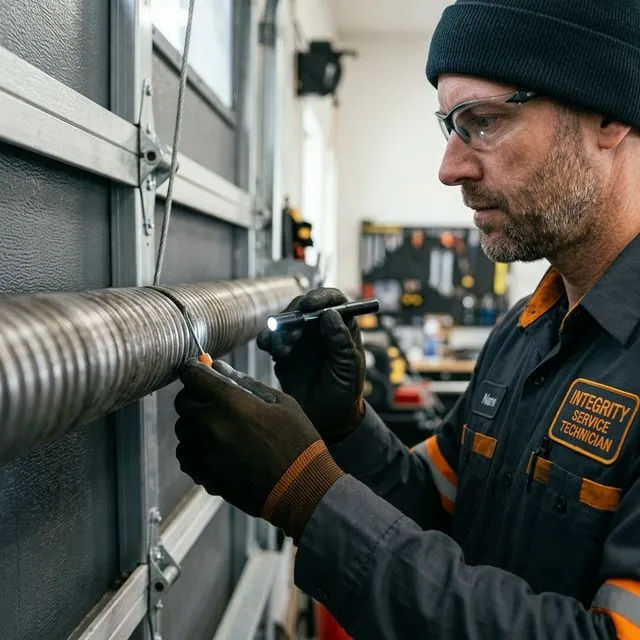
A good visit should end with a clear answer about the failed parts, the condition of the rest of the system, and whether a focused repair will restore reliable use.
That keeps the conversation grounded. Instead of a vague upgrade pitch, the homeowner gets a real explanation of what failed, what can be repaired, and why a replacement recommendation does or does not make sense.
The practical follow-up questions.
Does one broken spring mean the whole door should be replaced?
Usually no. A broken spring often means the spring system needs repair and the door needs to be rebalanced. Replacement is a separate conversation tied to the condition of the door itself.
When do panels push the job closer to replacement?
Replacement becomes more likely when panel damage is structural, repeated, or severe enough that the door can no longer run safely or hold alignment after repair.
Should I trust a company that talks about replacement immediately?
A good sign is whether they explain what failed first. If the conversation jumps straight to full replacement before the system is diagnosed, the recommendation may be too broad too early.
Move from the guide to the right page.
If this article matches what you are seeing, the next step is usually one of two things: go to the service page that fits the failure, or go to the city page that confirms local coverage and the most relevant repair paths.
City Repair Page
Rhome, TX
Garage door repair, broken spring replacement, opener diagnostics, and off-track door help for homeowners in Rhome.
View local page →City Repair Page
Fort Worth, TX
Garage door repair, spring replacement, opener service, and off-track door help across Fort Worth neighborhoods.
View local page →City Repair Page
Dallas, TX
Garage door repair and opener diagnostics for Dallas homeowners who need a clear answer and a repair-first recommendation.
View local page →City Repair Page
Keller, TX
Broken spring repair, opener troubleshooting, and stuck-door service for Keller homeowners who need the door working again.
View local page →More diagnostic guides for DFW homeowners
5 MIN READ
Signs Your Garage Door Spring Is Failing
A spring usually gives warning signs before it snaps. Here is what homeowners often notice first, what those signs usually mean, and when to stop using the door.
6 MIN READ
Why the Garage Door Opener Stopped Working
A garage door opener problem is not always a bad motor. This guide breaks down what can actually fail, what gets misdiagnosed, and what a proper opener check should include.